


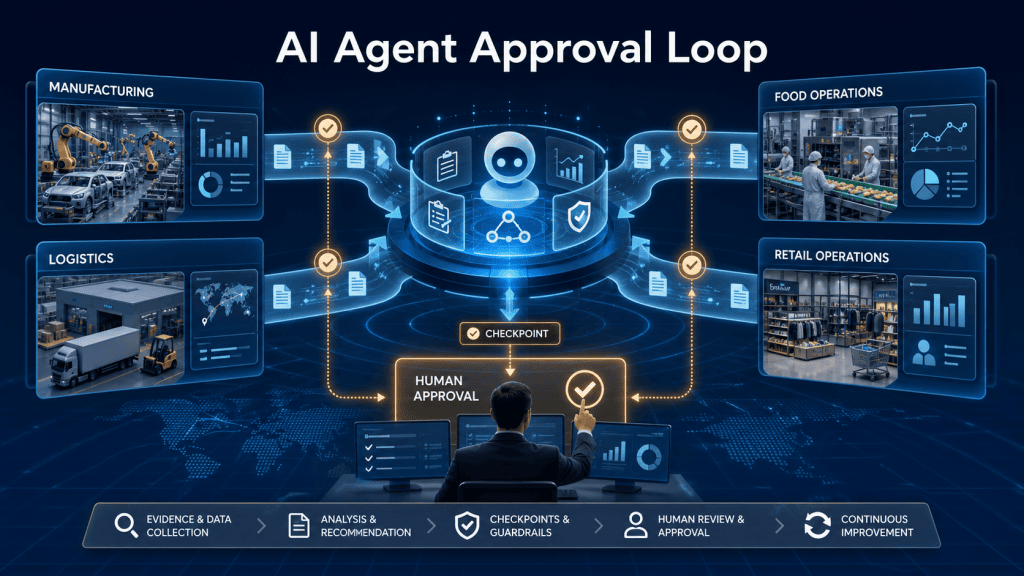
AI Agent Adoption Now Depends on Approval Loops: Business Notes for July 15, 2026
If I reduce today’s AI trend to one practical business idea, it is this: the advantage is starting to move away from model selection alone and toward approval-loop design.
Codex, Claude Code, and similar tools are no longer just chat systems that produce better answers. They are becoming bounded work systems. A task is assigned, files or tools are used, logs and intermediate artifacts are created, and output is returned to a human owner. That changes the implementation question for businesses.
The core issue is no longer only, “Can the model do this?” It is increasingly, “Who approves this output, under what conditions, and with what evidence?” That is why my reading on July 15, 2026 is that approval loops are becoming the real operating system of AI agent adoption.
Codex and Claude Code Point to a Delegation Model
OpenAI introduced Codex on May 16, 2025 as a cloud-based software engineering agent with parallel task execution, isolated environments, and verifiable logs. Anthropic introduced Claude 4 on May 22, 2025 and has continued to position Claude Code around long-running work, tool use, background execution, and IDE-connected workflows.
The important point is not just that both products are strong. It is that both products frame AI as a delegated worker under supervision, not as a final decision-maker.
- Tasks have boundaries.
- Execution leaves evidence.
- Uncertainty returns to humans.
- Output is prepared for the next owner.
That structure travels well beyond software. In fact, it often fits manufacturing, logistics, food, and retail better, because those industries already run on exceptions, escalation paths, and approval responsibility.
The Latest Signal Is Shifting from “Useful AI” to “Approvable AI”
The June 25, 2026 paper The Shift to Agentic AI: Evidence from Codex reported that active Codex usage grew more than fivefold in the first half of 2026, and that more than 10% of users managed three or more concurrent agents during a week. The most useful takeaway is not simple growth. It is that usage is moving from one-shot prompting toward parallel delegation.
At the same time, Stanford HAI’s 2026 AI Index Report says AI adoption is spreading at historic speed while responsible AI practices are not keeping pace with capability gains. The report also notes that documented AI incidents rose to 362 in 2025.
Put those together and the business reality becomes clear:
AI is no longer unusual. But it is also not simple enough to run without structured review.
That is why the practical early advantage is not maximum autonomy. It is the ability to make approval loops short, explicit, and reusable.
Industry by Industry, the Right Insertion Point Becomes Clear
Manufacturing
The 2026 Roadmap on Artificial Intelligence and Machine Learning for Smart Manufacturing puts digital twins, supply-chain optimization, LLMs, explainability, and trustworthy deployment in the same conversation. That is a strong signal that factories do not primarily need dramatic autonomy. They need reliable support in high-stakes workflows.
A practical first approval loop in manufacturing is the morning exception brief.
- Summarize overnight alerts.
- Pull similar failures and prior responses.
- Attach relevant procedures and part data.
- Return a one-page brief to the maintenance or production lead.
The value is not that AI stops the line. The value is that a human can decide faster whether the line should stop.
Logistics
The January 14, 2026 supply-chain disruption monitoring paper reports an agentic framework that processed multi-tier disruption signals in an average of 3.83 minutes at a cost of $0.0836 per disruption. In logistics, the value is not only detection. It is deciding who should receive the issue, at what priority, and with what mitigation options.
A practical logistics approval loop looks like this:
- Aggregate port, weather, customs, and supplier news.
- map likely SKU or route exposure.
- Narrow mitigation options to one or two actions.
- Send a short escalation brief into the morning decision meeting.
Again, this is not auto-approval. It is latency compression for human judgment.
Food
The November 17, 2025 food manufacturing white paper argues that AI can improve supply chain, formulation, processing, and consumer understanding, but that interoperability and skills gaps still slow adoption.
That makes document-heavy approval loops a good starting point in food operations.
- Read a raw-material specification change.
- Summarize the likely impact on quality, procurement, and production.
- Flag missing evidence or sign-off requirements.
- Return the same brief to all relevant teams.
In food, explainability matters more than speed alone. AI is most useful when it reduces cross-functional confirmation effort.
Retail
Large-scale online retail experiments show that generative AI can improve revenue and productivity in some workflows. But the 2026 Alibaba customer-service experiments also show that AI assistance can create uneven outcomes, especially when the timing of human intervention is poor.
That means retail performance depends less on blanket automation and more on where the handoff back to a person happens.
Retail-friendly approval loops include:
- Prioritizing abnormal review clusters.
- Grouping return reasons.
- Drafting product-description changes.
- Preparing a daily operating brief for store or e-commerce managers.
The key metric is not just response speed. It is escalation quality that people trust.
If Starting in 90 Days, Decide These 5 Things First
Before debating model rankings, lock in the operating rules.
- Limit the AI to one task family first.
- Fix the evidence fields that every output must contain.
- Define three to five conditions that force human review.
- Set a target time from signal detection to approval request.
- Review failed approval loops every week.
Those five choices are often enough to turn AI from a scattered experiment into an operational lever.
Conclusion
As of July 15, 2026, the most important AI agent trend is not simply “better standalone models.” It is work broken into human-approvable units.
Codex points in that direction. Claude Code points in that direction. Recent research across manufacturing, logistics, food, and retail points there too. The easier path to adoption is not spectacular full autonomy. It is structured output with evidence, sent back to the right human at the right moment.
The next executive question is not only which AI to buy or use. It is this:
Who receives the AI output, with what evidence, and at what approval point?
Companies that design that loop well will be the ones that turn AI from an impressive demo into repeatable operating infrastructure.
FAQ
What is an AI agent approval loop?
It is the workflow that returns AI-generated output to a human for review, approval, revision, or escalation, together with evidence, uncertainty, priority, and next actions.
Why is approval-loop design more important than model choice?
In many businesses, trust and governance block rollout before raw capability does. A strong approval loop makes limited deployment safer and easier to expand.
Where should manufacturers start?
Start with exception-heavy, evidence-friendly tasks such as overnight alert summaries, quality issue triage, or maintenance briefing packets.
Should logistics or retail aim for full automation first?
Usually no. Approval-style flows for disruption monitoring, return analysis, review triage, and daily operating briefs are easier to measure and control.
What KPI should leaders track first?
Track initial investigation time, time to approval request, missing-evidence rate, rework rate, and recurrence of the same exception type.
References
- OpenAI, “Introducing Codex,” May 16, 2025
- Anthropic, “Introducing Claude 4,” May 22, 2025
- Anthropic, “Overview – Claude Code Docs”
- Stanford HAI, “The 2026 AI Index Report”
- Johnston et al., “The Shift to Agentic AI: Evidence from Codex,” Jun 25, 2026
- Lee et al., “2026 Roadmap on Artificial Intelligence and Machine Learning for Smart Manufacturing,” Apr 5, 2026
- AlMahri, Xu, Brintrup, “Automating Supply Chain Disruption Monitoring via an Agentic AI Approach,” Jan 14, 2026
- Zhou et al., “The Future of Food: How Artificial Intelligence is Transforming Food Manufacturing,” Nov 17, 2025
- Fang et al., “Generative AI and Firm Productivity: Field Experiments in Online Retail,” Oct 14, 2025
- Ni et al., “Generative AI in Action: Field Experimental Evidence from Alibaba’s Customer Service Operations,” Feb 8, 2026


