


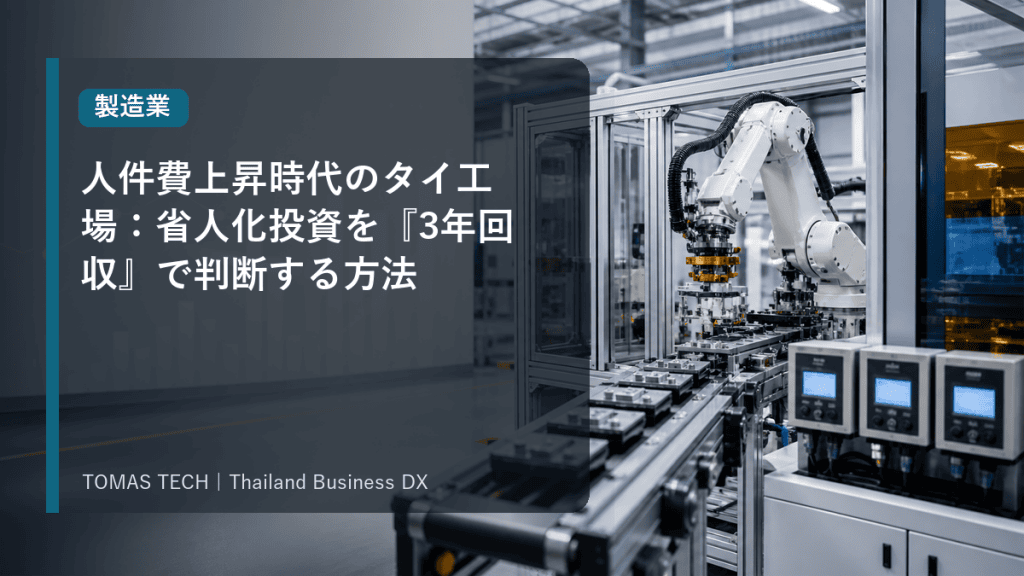
The model of adding people to keep the shop floor running has become harder than before, due to rising minimum wages and difficulty in hiring. As Thailand’s economy heads toward 2026, slowing growth is increasingly on people’s minds, and across manufacturing, logistics, and consumer-facing operations, costs and management burdens that cannot be absorbed simply by growing revenue are mounting. At the same time, BOI is encouraging investment related to automation, AI, data analytics, enterprise management IT, and Industry 4.0—so this is a period in which the moments to hold back on investment and the moments to actively push forward coexist.
Automation investment should be discussed not in terms of “becoming more convenient,” but in terms of how many hours it saves, which losses it reduces, and over how many years it pays back. What matters is not DX as a buzzword, but DX that connects to shop-floor numbers and management decisions. The challenge that TOMAS TECH must address for Japanese companies is not merely installing systems, but standardizing operations at Thai sites, reducing reliance on individuals, and creating an investment return that can also be explained to the Japanese head office.
1. Why this theme matters now
In Thailand in 2026, while overall economic growth slows, structural challenges remain—labor costs, energy, logistics, quality response, and a shortage of managers. In good times, some waste can be absorbed by revenue, but in a period of sluggish growth, small inefficiencies on the floor directly erode profit margins.
For this reason, investment decisions are no longer as simple as “proceed because the economy is good” or “stop because the economy is bad.” What should be stopped are large investments with vague objectives. What should proceed are investments that move concrete numbers: hours saved, inventory discrepancies, defects, downtime, missed billing, scrap, and waiting time.
2. Problems that tend to arise on the floor
The model of adding people to keep the shop floor running has become harder than before, due to rising minimum wages and difficulty in hiring. What makes this problem troublesome is that it does not stay contained on the floor. When floor records are delayed, the management division’s aggregation is delayed; when the management division’s numbers are delayed, management decisions are delayed too. Furthermore, when explaining to the Japanese head office, the problems occurring locally are hard to convey with a sense of urgency, making investment approvals harder to obtain.
At Thai sites, information in Japanese, Thai, and English is intermixed, and paper, Excel, existing systems, chat, and email tend to be fragmented. This very fragmentation is the first target of DX. Before expensive equipment or large-scale systems, the flow of information must first be put in order.
3. Points to watch in investment decisions
There are three points to watch on this theme:
- Convert monthly hours saved into a monetary value
- Include defects, downtime, transcription, and stocktaking discrepancies in the investment return
- For head-office approval requests, separate quantitative effects from risk reduction
These are not mere functional requirements. They are management requirements for explaining the investment return. How many hours can be saved per month, which errors are reduced, which risks can be detected sooner, and can it pay back within three years? An investment that can be explained in these terms is worth pursuing even in a period of sluggish growth.
4. Implementation steps to start small
Step 1: Narrow to a single target operation
Aiming for a company-wide rollout from the start makes requirements expand too far and stalls. First, narrow to a scope where the effect is easy to see—one process, one warehouse, one store, one form, or one meeting.
Step 2: Do not increase the input burden on the floor
A major reason DX fails is that it adds to the floor’s work. You need to choose input methods that are natural for the floor, using QR codes, barcodes, sensors, voice input, integration with existing Excel, and the like.
Step 3: Build it into meetings and KPIs
Data will not be used if there is no place to look at it. Build it into weekly meetings, morning briefings, quality meetings, sales meetings, and monthly reports, and decide who judges what.
Step 4: Record the effect in numbers
Record hours saved, defect reduction, shorter waiting times, less scrap, fewer missed billings, and so on. This becomes the material for the next investment approval request.
5. A way of thinking about BOI and incentive schemes
BOI places importance on investments that contribute to upgrading Thai industry—automation, robotics, AI, big-data analytics, IT for enterprise management, cloud utilization, and more. Whether a specific case actually qualifies requires individual confirmation, but at the very least it is worth keeping BOI’s direction in mind in the early stages of an investment plan.
What matters is to organize the plan not as mere equipment purchase or system installation, but as an investment plan that includes productivity improvement, quality improvement, labor saving, data utilization, and sustainability. This works not only for BOI but also for explaining to the Japanese head office.
6. What TOMAS TECH can support
TOMAS TECH supports everything from shop-floor observation to payback simulation, PoC, and phased implementation, in a form that starts small. TOMAS TECH’s strength lies in being able to think through the on-the-ground reality of Japanese companies in Thailand, explanation to the Japanese head office, system implementation, AI utilization, and accounting DX as a single flow.
Simply building exactly what is requested, as in contract development, can amount to merely transferring the floor’s complexity into the system. What is needed from here on is support premised on standardization, non-customization, phased implementation, and operational adoption. Build small, use it on the floor, measure the effect, and roll it out to the next area. This approach is the most realistic for Thai sites.
Summary
The theme of “Thai Factories in an Era of Rising Labor Costs: How to Judge Labor-Saving Investments by a ‘3-Year Payback'” is not merely a story of IT adoption. Amid an environment of slowing growth, rising costs, talent shortages, and heightening quality demands, it is a management theme of how Thai sites protect their profit margins and shop-floor capability.
What is needed in 2026 is not flashy DX, but DX that changes shop-floor numbers. Separating investments to stop from investments to pursue, and accumulating small improvements that can be discussed in terms of a 3-year payback, is the most solid growth strategy for Japanese companies in Thailand.
Reference information
- World Bank: Thailand Economic Monitor February 2026
- S&P Global Thailand Manufacturing PMI
- Thailand BOI Investment Promotion Guide 2025
- PwC Thailand: Corporate tax credits and incentives
Related Articles
- Thailand Manufacturing in 2026: Which Investments to Stop and Which to Push Forward
- Preparing for Slowing External Demand in Thai Manufacturing: A Data Utilization Strategy to Strengthen Your Factory Even When Orders Decline
- IoT for Aging Equipment in Thai Factories: Starting Your Smart Factory Journey Without a Full Overhaul
- What Should Japanese Suppliers in Thailand Change in Response to the EV and Electronics Component Shift?


